• Home
  • Products
    • 111 Ways to Save
    • Thrive in Five: Take Charge of Your Finances In 5 Minutes A Day
    • Cash, Credit, and Your Finances: The Teen Years
  • Resources
  • Speaker Info
    • Adult
    • School Age
    • Speaking Engagements
  • About Jill Russo Foster
  • Press/Media Kit
    • Full Media Kit
    • Bio
    • Photos
    • TV Appearances
    • Print Appearances
    • Radio / Podcast Appearances
    • Speaking Engagements
    • Press Releases
  • Contact Jill

Jill Russo Foster

Tips for Successful Personal Finances

  • Events
  • Every Day Finances
    • Banking
    • Budget Planning
    • Family Finances
    • Personal Finance
    • Reducing Expenses
    • Shopping Tips
    • Teenagers and Money
  • Protecting Your Home
    • Disaster Preparedness
    • Energy Efficiency
  • Tax Tips
    • Charitable Giving
  • Manage Your Credit & Identity
    • Debt Management
    • Mortgage Tips
    • Get Great Credit
      • Loans
      • Credit Card Act of 2009
      • Credit Management
      • Credit Report
      • Credit Report Reminder
    • Identity Theft & Fraud
      • Identity Theft
      • Fraud Alert
  • Organization & Planning
    • Organizing Your Space
    • Organizing Your Time
    • Vacation Planning
      • Travel Tips
    • Plan for the Future
      • Financial Goals
      • Marriage and Finances
      • Retirement Planning
You are here: Home / Archives for Every Day Finances

Double Your Savings with Matching Funds

I get this question all the time: “How can I make my money grow faster?” I’m not an investment broker, so I can’t give you advice on buying stocks or bonds. And, personal savings accounts don’t pay as much interest as they used to, so I can’t help you there either.

But, there are two types of savings plans that offer matching funds, which means that your employer, or your state, will put their own money into your account to increase the money you put into the account.  Never turn down FREE money!  (Normally, I would tell you that there is no such thing as free money, but with these 2 plans there really is.)

Employer Matching Funds in Employee 401K Plans

If you work for an employer that offers a 401K or retirement savings, participate in the plan as soon as you are eligible.  If you are eligible and you haven’t signed up yet, find out how soon you can start. Many companies offer to match your contributions. Not only that, but you will  be putting your pre-tax dollars into this account, which means you can report less income for income tax purposes. That could mean a bigger tax refund or a smaller tax bill.

If you think you don’t have enough money to contribute, start out small and then increase your contributions.  I have clients who did just that, who haven’t felt the loss in their monthly budgets. Remember: the first decision is to start to save. After that, you’ll find a way.

State Matching Funds from an Individual Development Account (IDA)

Another way to get matching funds is from an Individual Development Account (IDA).  These accounts were designed to promote good money management and to teach savings habits. To open an IDA account, you need to have a specific goal in mind, such as saving for a home down payment, starting a small business, tuition for post-secondary education, etc.  Once you meet eligibility requirements, you will put money in your IDA account on a regular basis, and your funds will be matched.  Check with your individual state for eligibility and participating organizations.

But, what if you aren’t eligible for a 401K or IDA?

Don’t be discouraged. If you’ve made the decision to save on a regular basis, set it up to happen automatically. It’s the best way to make your money grow.  If you have to go to the bank to put cash into savings, something will come up and you will decide to spend it instead. You will tell yourself that you’ll save next week, then next week comes and goes and you still won’t deposit the money into savings.  When you have it taken out of your paycheck automatically, you never see the money, so it’s less tempting to spend it. With interest and time, your money will grow.

Tips for reducing car insurance costs

While you’re doing your taxes this month, you can be assessing your finances and looking for ways to save. Here are some tips that might save you money on your car insurance:

  • Most insurance companies will offer a discount for multiple policies, so try to have all your insurance policies with one company.
  • Consider a higher deductible. Remember, the deductible is the amount of money you might have to come up with if you have an accident.
  • Pay your premium in one yearly payment instead of monthly. Companies will sometimes add installment fees for multiple payments. There will also be late fees if your payment is not received by the due date.
  • You may be able to lower your car insurance premium by taking a defensive driving class.
  • Talk to your agent or insurance company to make sure that you’re taking advantage of all available discounts. Do you commute to work by bus instead of using your car? Do you have students on your policy who are away at school and only drive a limited amount of time. Does your car have certain safety features? Any of these scenarios could mean a lower premium.

In addition, you may want to check with other companies to see what they charge.  It never hurts to comparison shop.

A bad credit score can also increase your car insurance. Join me on February 20 for our call Could Your Credit be Costing You Money?

Should you move your money?

Since the Credit Card Act of 2009, banks have been looking for ways to make up for lost revenue.  Has your bank increased fees or even added new fees? Look for changes in…

  • overdraft fees
  • inactivity fees
  • annual fees
  • ATM fees

This past month, a major bank decided against adding a debit card fee.  I believe that negative consumer response was the only reason they changed their plan. Their customers did not want to pay to use a debit card and they made their voices heard.

But what if the protests hadn’t worked? Being a consumer means you have a choice. You don’t have to stay with the same bank. You can choose a bank, or even a credit union, that has no fees or minimal fees.

It’s very simple to move your money.  If you are unhappy with your bank, do some research and change banks.  There are plenty of banks and credit unions that will give you a free checking account with no ATM fees.

Some banks have investment policies or divisions that made them more vulnerable during the crisis. These banks are going to have to make up lost revenue. Even though that particular bank did not go forward with the new debit card fee, they may find a less controversial way to increase their fees.

You need to be aware that fee increases could be coming your way. Look at your monthly statements and the inserts. Be aware of what is going on at your bank so you can be proactive.

What is a Pantry Purge?

If you read my Suggestions for Lowering Your Expenses, then you know that I want to lower my food spending.  I took the advice of several friends and colleagues and did a pantry purge.

A pantry purge is where you eat the food in your pantry and freezer instead of buying new. I don’t mean that you eat that and nothing else, or that you eat it in a big binge. It simply means that you don’t buy any processed or frozen foods until your panty and freezer are empty. You will purchase only perishable fresh fruit, vegetables, or dairy products.

I wasn’t always sure what to make with the foods I had on hand. So, I went to recipe sites online and entered the ingredients to see what came up.  Some were great and I will make those again… others were not so great.  I made some new kinds of homemade soups (that gave me extra to take for lunches), and I combined ingredients that I probably would not have otherwise.

Bottom line, I emptied out the food pantry as well as substantially cut my food spending. I learned that a little more planning ahead for the week’s meals, and less buying, is better for my budget.  Buying something just because it’s on sale is not better for my spending.  And yes, sticking to my list when in the store, and not impulse buying, was the biggest saver.

Buy Used to Save Money

Do you want to save money?  That’s probably a silly question, because everyone wants to save money. Let’s think of a better way to say this. Do you want to try another way to save money?  I have a really simple suggestion – don’t buy new.

You’ve probably heard this advice when you were buying a car. A new car depreciates the minute you drive off the lot. If you buy used, you can negotiate a price that’s closer to its real value. Expand your thinking to other items and you could save money.

Let’s discuss furniture. Most people buy brand new furniture, but it doesn’t last forever – especially if you have kids and pets. What if you were to buy that sofa used – how much could you save? There are stores that specialize in selling gently used furniture, either on consignment or from furnished rentals. Much of this furniture is in great condition.

Many years ago (over 15), I was able to purchase our patio set – table for 6 with chairs, a chaise lounge and end table.  The cushions had seen better days, but the furniture was in excellent condition.  I paid $100 for all the pieces.  I still have this set in the yard.  All I had to do was purchase new cushions.

Let’s talk about kitchen items. Dishes, silverware and small appliances are always available at tag sales. Some of these items have never been used. Think of how many times you’ve been gifted with something you didn’t need. You can find brand new coffee makers, mixers, waffle-makers – still in the box with instructions – for sale cheap by your neighbors.

What about clothes? My assistant lost weight a year ago and didn’t want to spend a lot of money on new fall clothes. She went to a consignment shop and a thrift store and spent $40. What did she get? With $40 she was able to 4 pairs of jeans, 3 sweaters, 2 jackets and 4 long-sleeved knit shirts – all relatively new and in good condition.

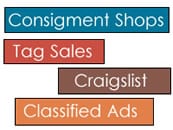
Let’s be clear here, I am not talking about items that should have been thrown out. You can get good quality items. Depending on what you need, you can look at tag sales, consignment shops, websites, classified ads, etc.

I am not suggesting that you buy everything used.  There are some things that come to mind that you shouldn’t buy used – underwear and makeup just to name two.  But the next time you need something, consider the alternative.  Have you saved money by buying used?  Tell me about it.

Suggestions for lowering your expenses

You know how tracking your spending and budgeting are important things to do.  These are the only ways that you can make the changes necessary to achieve your financial goals.

After suggesting that you track your spending, I did a month of tracking for my family. It was an eye-opener. Here are some of the changes we made:

  • Decreased our TV bill by eliminating channels and services
  • Eliminated some of our cell phone services that we didn’t use
  • Used a local pet store for some of our pet’s vaccinations (instead of the vet)
  • Planned our meals a week in advance using the supermarket sale flyer
  • Cooked ahead on weekends so that there was food available to eat for lunches

These reductions in cost saved us enough money that we were able to make some necessary home repairs without having to stress about tapping into savings to pay for it  Our furnace is cleaned and tuned up for the winter, our roof is repaired, and the car had a tune up – all things that needed to be done, but were things I would have considered “budget-breakers” before reducing our expenses.

Our food spending is still higher than I would like, and I need to get that down even more.  Next week, I will tell you what I did to reduce our grocery bill while still cooking meals at home.

Did you do the budget exercise with me?  I know that several of you requested my budget worksheet.  What did you learn about your spending?  Let me know.

Layaway for the Holidays

I was in Costco before Labor Day and they already had holiday displays. They seem to “deck the halls” earlier and earlier as each year passes. Personally, I am not thinking about the holidays this early, but it’s not a bad idea to think ahead.

How are you going to pay for your holiday purchases? Do you have savings set aside for this time of year?  If not, you are not alone.

In this economy, stores are lobbying for dollars and they want yours. They know that people are cutting back on credit card spending so they’re bringing back layaway plans.

What is a layaway plan? It’s a little like store credit, with one big exception: the store keeps your purchase until you’ve paid in full.

Here’s how it works.

  • You pay a down payment or deposit to start the process
  • You may have 30-90 days or a “must be paid by” date that coincides with a holiday
  • Usually, you can pay as often as you like. Many people pay weekly (after they get paid themselves).
  • As soon as your purchase is paid in full, you can take it home.

Why use a layaway plan? It may help you stay within budget. Credit cards make you feel like you have endless money to spend. If you can walk out of the store with that cashmere sweater, then it’s all paid for, right? Wrong! Some people won’t have their holiday credit card bills paid down until next spring. A layaway plan, on the other hand, never lets you forget that you’re paying installments.

What are the costs?

As with any installment payment plan, there will be fees.

  • Many stores charge a fee for layaway. For example, Wal-Mart is charging a five dollar fee, and Best Buy charges a five percent fee.  These fees are typically non-refundable.
  • In addition, there could be a cancellation fee if you change your mind.

Which retailers are offering layaway plans this year? I know of  T J Maxx, Marshalls, Toys R Us, Wal-Mart, K-Mart, and Best Buy. There are probably more.

You might be thinking, “Should I sign up for a layaway plan now or wait for the Black Friday sales?” That’s a question only you can answer. If you want to wait, start your own “layaway plan” by putting aside cash each payday. That way, you’ll have money for your purchase by Black Friday, whether it goes on sale, or not.

Debit or credit?

Which should you use: a debit card or a credit card?  You all know the difference between the two – a debit card uses your own money and a credit card means borrowing  with interest.

Here is what I recommend:

Use a debit card when…

You make everyday purchases in person.  These are items that are part of daily living: groceries, doctor co-pays, restaurant meals, etc.

Use a credit card when…

You are purchasing big ticket items, anything with a warranty, travel reservations, online purchases, etc.  Using a credit card will (usually) give you extra consumer protection for little or no additional cost.

More about that added layer of protection:

When you travel, certain credit cards give trip insurance for items such as lost luggage protection.  If you are purchasing electronics, some credit cards extend the warranty period. If you purchase something online and it never arrives (or arrives broken), you can dispute the charge with your credit card company after you have attempted to resolve this with the merchant.  You should check with your credit card issuer to see what benefits you have with your credit card.  Then make your purchases where you will get the most benefits.

Planning for 2012 Financially

I have to admit that I am a planner – I already have my 2012 calendar.  Even if you prefer to live in the moment, you have to admit that some areas of your life must be planned ahead.

For example:  if you are a homeowner and have your homeowner’s insurance escrowed, you can’t just switch insurance companies a week or two before the policy is set to renew.  You need to make the changes ahead of time so that your mortgage servicer can send the check to the new insurance company.

Getting divorced? You might have to make alimony or child support payments. Children grown? Your alimony or child support will be ending soon. Is your employer struggling? You could see a reduction in wages, medical coverage or even be laid off.

Finances can be overwhelming.  They certainly can be if you have to make many changes in a short amount of time.

I pencil noteworthy financial dates in my calendar to help me start the process early.  In my case, my homeowner’s insurance policy will expire in early February.  I don’t want to tackle this project during the holidays, so it’s on my calendar to do in early December.

Thinking ahead will save you the eleventh hour stress.  Look at your year and pencil in the important changes you have coming in your future. By addressing these matters with time on your side, you can do more comparison shopping and make changes to save money.  Get out your 2012 calendar and start planning.

Using layaway for holiday shopping

I know you don’t want to hear this, but the holidays are about 3 months away. Are you ready to do some shopping?

If the answer is “no”, then consider this:  retailers are bringing back layaway plans. They’ve noticed that people are spending less because money is tight and they want to keep that holiday cash flowing.

Layaway plans offer you the convenience of making payments over time so that you can budget your purchases.

What you should know about layaway plans:

  1. You can’t take your purchase home with you until it is paid in full. The store keeps it until you make your final payment.
  2. There is typically a small fee for the layaway plan.
  3. If you change your mind there can be a cancellation fee as well.
  4. Payment plans are typically 60-90 days.

Why not use your credit card instead? With a credit card you might pay more in interest and take longer to pay it off. You may also spend more because you can take your purchases home with you, giving you a satisfied (but very wrong) feeling that your work is done.

Layaway plans could be the better option if you cannot afford to pay for your purchase in one payment.

Isn’t it better to just wait for a sale?

What if it doesn’t go on sale? You have to decide if it’s better to buy now on layaway or wait until Black Friday when there may, or may not, be a lower price. If Black Friday is your choice, then you can create your own layaway plan by saving money each pay period so you have the cash to make the purchase. That way, whether it’s on sale or not, you can get that special gift.

Either way, the holidays are coming and that is the time of year that we tend to break our budgets.  Start early and spread out your purchases.

  • « Previous Page
  • 1
  • …
  • 29
  • 30
  • 31
  • 32
  • 33
  • …
  • 37
  • Next Page »
  • Facebook
  • LinkedIn
  • Pinterest
  • Twitter
  • YouTube

Contact Jill:

Email: jrussofoster@gmail.com or use this form.

Looking for something?

Follow Jill Russo Foster’s board Money on Pinterest.

Copyright © 2026 Jill Russo Foster