• Home
  • Products
    • 111 Ways to Save
    • Thrive in Five: Take Charge of Your Finances In 5 Minutes A Day
    • Cash, Credit, and Your Finances: The Teen Years
  • Resources
  • Speaker Info
    • Adult
    • School Age
    • Speaking Engagements
  • About Jill Russo Foster
  • Press/Media Kit
    • Full Media Kit
    • Bio
    • Photos
    • TV Appearances
    • Print Appearances
    • Radio / Podcast Appearances
    • Speaking Engagements
    • Press Releases
  • Contact Jill

Jill Russo Foster

Tips for Successful Personal Finances

  • Events
  • Every Day Finances
    • Banking
    • Budget Planning
    • Family Finances
    • Personal Finance
    • Reducing Expenses
    • Shopping Tips
    • Teenagers and Money
  • Protecting Your Home
    • Disaster Preparedness
    • Energy Efficiency
  • Tax Tips
    • Charitable Giving
  • Manage Your Credit & Identity
    • Debt Management
    • Mortgage Tips
    • Get Great Credit
      • Loans
      • Credit Card Act of 2009
      • Credit Management
      • Credit Report
      • Credit Report Reminder
    • Identity Theft & Fraud
      • Identity Theft
      • Fraud Alert
  • Organization & Planning
    • Organizing Your Space
    • Organizing Your Time
    • Vacation Planning
      • Travel Tips
    • Plan for the Future
      • Financial Goals
      • Marriage and Finances
      • Retirement Planning
You are here: Home / Archives for Jill Russo Foster

What will your retirement income be?

Remember these?

20150424-socialsecurity

You used to receive one in the mail around your birthday. If you are younger than 50, you probably threw it directly into the trash. (It’s much more interesting the closer you get to retirement.)

Now you can just go online

To see your Social Security statement, go to www.SSA.gov (If you have trouble remembering it, just think “ass backwards” then “gov”). You’ll need to set up an account with the typical personal details plus security questions to verify your identity. If you want added security, you can take it a step further and use information from a prior year’s W-2.

Why do you want to see it?

  • To verify your earnings. It’s a lot easier to correct errors when they are new.
  • To help you plan how and where you will live at retirement. You can see how much you will earn when it’s your time to collect. Is it enough to cover your mortgage payment? Is it enough to continue with your hobbies or cover basic expenses?
  • To help you decide when to retire. You will be able to determine your Full Retirement Age (based on year of birth). Currently, you can take your social security benefits early at age 62 with a lower monthly payout or wait as late as 70 to receive a greater payout.

Protecting your account

You can add extra security by having them text you a unique code every time you want to sign in online. In a surprise twist, setting this up initially involves them sending you a letter in the mail. It’s a process that takes 5-10 business days, but once it’s done, you can rest a little easier. I recommend taking this extra step, since everyone’s had their information compromised at least once or twice in the last few years.

I would suggest that you check your Social Security statement annually – either a month or so after you file your income tax or around your birthday. The important thing to do is to check it.

Read about Jill in the Stamford Advocate

Personal bankruptcies on the rise

With bankruptcies up, Women’s Business Development Council offers help
By Alexander Soule
Published 1:00 am, Sunday, April 19, 2015
StamfordAdvocate.com

2015-StamfordAdv1Maclyne Josselin might catch the eye of any corporate comptroller looking to build a staff, keeping a ledger within arm’s reach in which she tracks income and expenses to the penny.


Josselin’s business these days is managing her own personal finances — and “profits” have been exceeding “losses,” a welcome change from just a few years ago.

Despite an improving jobs market, and slightly higher wages and savings in Fairfield County in the past year, not to mention low oil prices and a surging stock market in the macroeconomy, personal bankruptcies rose 5.8 percent in the region last year to just over 1,500.

The local increase comes in the context of a 12.2 percent drop nationally in people seeking protection from creditors, and underscores a fragile economic recovery that is still causing pain for many, amid slow wage growth and high costs of living in Fairfield County.

While financial crises can strike from any number of directions beyond one’s control –job loss, health problems and family demands, to name a few — Josselin said she edged toward the financial cliff by living paycheck to paycheck on a nonprofit employee’s salary without eyeballing what she was spending, and was unable to save anything.

Josselin, a Stamford resident, said she was able to make the conscious decision to reverse her course, but it was difficult.

“It’s like breathing,” Josselin said, describing the habit she has honed of tracking her expenses daily. “Just getting started was the hardest part.”

With nothing to lose, Josselin began attending a free clinic on personal finance that the Women’s Business Development Council offers at its headquarters in Stamford, as well as at satellite offices in Danbury, Shelton and Hartford.

Jill Russo Foster runs WBDC’s personal financial education and budget coaching programs, and has written multiple books on personal finance, including “Thrive In Five: Take Charge of Your Finances In Five Minutes A Day.” She became an expert on the topic the hard way, saying she accumulated 27 credit cards while in her 20s before the inevitable financial disaster hit, requiring a couple of years to work to fix her credit problems.

Josselin would eventually hammer out a plan that worked to control her spending by tracking every penny — literally — that she pays out. She keeps it all in a binder she has titled “Young, Fabulous and Saving,” deriving it from the Suze Orman book “The Money Set for the Young, Fabulous & Broke.”

From student to tutor

Today, Josselin is one of WBDC’s volunteer budget coaches, having tutored three people to date in a half-dozen, one-on-one sessions spanning three months. It was intimidating at first, she said, with her first client a woman many years her senior.

Foster said about half of the people who go through the program have income putting them below the official federal poverty. Of the remaining half, she said she has counseled spouses with combined income as high as $190,000, who have fallen on hard times due to health issues, divorce or other calamitous life events.

WBDC’s advanced budget coaching sessions for people in financial crisis entail four major tenets. Perhaps surprisingly, the easiest is reducing debt, while the hardest is improving one’s credit score, mainly due to the fact it is hard to move that needle in the six-week span of the program. The other two legs of the stool are increasing one’s income-to-expenses ratio and boosting savings.

Of those who register for WBDC’s budget coaching programs, 85 percent say they have changed their spending habits. Though Foster would like to close that 15 percent gap to zero, it nevertheless is making a difference. With a staff of 16 people, five part-timers and volunteers, WBDC helps as many people as it can.

Since 2005, when Connecticut experienced a surge of bankruptcy filings before Congress stiffened rules on who could qualify, statewide bankruptcies have stayed in rough lockstep with the economy. From just under 4,000 filings in 2006 –likely an abnormally low number due to people filing in advance of the new rules — personal bankruptcies marched steadily upward to peak at nearly 11,250 cases in 2010, before receding each year to 6,750 cases last year.

Behind most of those cases there is an individual or family who has hit rock bottom, unable to make ends meet whether due to a lost job, medical bills, poor planning or bad luck.

Foster said there are common traps many people fall into, including deciding to postpone payment of a bill coming due in order to be accumulate funds to pay it off in full. Better to pay some of it right away and the rest when one is able, she said.

A utopian world

Hand in hand with bankruptcy is home foreclosure, with Corelogic tracking nearly 5,240 foreclosure proceedings in Connecticut for the 12-month period through February.

Both bankruptcy and foreclosure data can be influenced by external factors, according to Mark Stern, a Fairfield attorney who chairs the Bankruptcy Law Committee of the Fairfield County Bar Association. Those factors can include changes in bank policies regarding foreclosures or judicial retirements resulting in a backlog of cases.

Stamford state Superior Court Judge Douglas Mintz told Connecticut legislators in February that in 2012 and 2013 an increasing number of people participated in a foreclosure mediation program mandated in 2008 by the state. He said the program has helped 15,000 Connecticut families stay in their homes — 69 percent of whom signed up for mediation — and requested that the state make the program permanent.

“It would be a wonderful, utopian world where, you know, I would not have to do a foreclosure docket on a Monday morning,” Mintz said. “Even in the good times, people get sick and lose their job.”

WBDC CEO Fran Pastore said her organization had initially intended to end the budget coaching sessions led by Foster once the economy gained steam again, but now intends to keep it in place.

“We can’t even meet the demand of the number of people who want to get into the program,” Pastore said. “The despair is so real and it is very much alive ” a sense of despondency, despair — nowhere to turn.”

Josselin said she was able to turn it around just by taking the first step, and the next, and the next. She is now sharing her experience with others, and Foster suspects more will make the transition from student to tutor on what can be a long, hard road to financial stability — one people from up and down the various walks of life have traversed.

“What I try to tell people is that there is no shame or guilt about what happened in the past,” Foster said. “Just come in and start addressing it.”

Alex.Soule@scni.com; 203-964-2236; www.twitter.com/casoulman

Financial Spring Cleaning: What do do first?

blog-hop

Welcome to our April Blog Hop!

This month we are so excited to help you reach your business and life goals, featuring articles, how-to’s and resources for you today that have helped each consultant, blogger and business owner on the hop in their own lives and businesses. Get ready to be inspired for a fabulous month ahead of you as you move along through the blog hop.

You may just be starting the blog hop or may have come from 3. Kim McDaniels at iBiz Design Duchess on Natalie Bradley’s Blog Hop. If you get off track at any time, the full lineup below will help you move along from blog to blog so you make sure to see and learn from all of the articles featured here today.

Financial Spring Cleaning: What should you do first?

Have I ever had credit card debt? Yes! There have been times in my life when I haven’t been able pay my balance in full when the bill arrives.

Credit card debt is the enemy of a good budget, but life happens. Even the best budgeter can have unplanned expenses.

According to a recent study by Trans Union, the average US adult carries $4,878 in credit card debt. That doesn’t include zero percent balances. That means the average US adult owes almost $5,000 plus the additional interest.

If this is you, I want you to take a deep breath. Debt repayment is just financial housework. There’s nothing to be afraid of here.

mirrorDo you know what’s really scary? Having company due in 5 minutes when the bathrooms aren’t clean. When that happens, do you lock the front door and pretend you’re not home? No! You walk into the bathroom and decide which part needs to be cleaned first (just in case you run out of time before the doorbell rings).

That’s right. I just compared paying off credit card debt to scrubbing the toilet. smiley-1 That’s because you want to use the same thought process with your credit cards. Some cards will need more attention than others, so you need to make a list of your debts which includes the interest rate and minimum payment amounts.
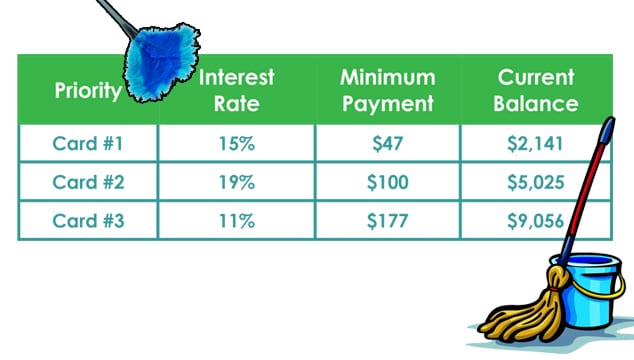
There are two methods to setting priorities on your credit cards.

Option 1: Pay the highest interest rate first. Your list will look something like this:

20150415-rate

This is the best option if you want to save money. Using the example above, you pay as much as your budget will allow on card #1, and only the minimum on cards #2 and #3. When #1 is paid off, you make card #2 the highest priority. Rinse and repeat until all cards are paid in full. When you pay the highest interest rate first, you pay less overall.

Option 2. Pay the smallest debt first. Your list will look something like this.

20150415-amt

This option is good if you need to see results to stay motivated. Receiving a bill with $0 due is really satisfying. A positive emotional boost can really keep the momentum going. You can compare it to housework, dieting, or exercise. We like to see improvements.

Bottom line: You have chosen to get out of debt (your goal) and the actions that will get you there (your plan). You’ll know the best option for you and your family, and you can change tactics whenever you want as long as you’re moving forward.

Let us know which option you choose and how you are doing.

The next stop is  5. Robin Hardy at Integrity Virtual Services on Natalie Bradley’s Blog Hop! Thanks for visiting and I hope to see you again next month!

Blog Hop participants lineup:

    1. Natalie Bradley at Natalie Bradley Consulting
    2. Deb Brown at Touch Your Client’s Heart
    3. Kim McDaniels at iBiz Design Duchess
    4. Jill Russo at JillRussoFoster.com  <<– you are here!
    5. Robin Hardy at Integrity Virtual Services

Clutter: It’s time to let it go

Stuff.

It’s easy to come by and we all have too much (including me). But is it hurting you? It could be. Clutter is a budget breaker. I won’t go into details in this article, but trust me that having more makes you spend more. You’d think that once you had everything you’d stop spending. You’d be wrong.

Are you using that?

When you’re busy, things get messy. So how do you know if you have clutter or a mess? According to my friend Matt Baier, of Matt Baier Organizing, you should ask yourself whether it has a pulse:

Here’s an example of a living mess and an example of true clutter. If there is a playroom full of toys, all over the floor and they will be moved around and played with tomorrow, that’s a living mess. If, however, there’s a room full of toys and the kids have moved out and have kids of their own now, that’s true clutter. It has stopped moving. The heartbeat is gone. It’s dead.

Unfortunately, we had a lot of dead clutter.

17370157_s-2

Save it for a rainy day… I mean the project not the object

We needed to tackle our clutter, but I wouldn’t waste a sunny day on it – or even a whole day.

This is what we did on snowy weekends this past winter.

  • Scanned documents from the file cabinet, then shredded and recycled the paper (medical records, income taxes, etc.)
  • Digitized the notes, workbooks and CDs from conferences we attended – now it’s all filed in the computer and backed up.
  • We did a major cleaning of the basement.  In our house that is where things get put that don’t have a place.  Plus, living in a family home, we have stuff from our parents – photos and memorabilia that I wanted to preserve.  It’s not all done, but it’s well on its way. We are tackling the basement one box and one shelf at a time.
  • Donated some useful items.  We found several old cell phones that we donated to an organization that gives cell phones to battered women. We cleaned out the books for a donation to the library.
  • We cleaned out the pantry and got rid of foods we no longer choose to eat.  Some was donated to the local food pantry.

The bittersweet goodbye is mostly sweet

There are so many positives with decluttering. It’s not all heart wrenching goodbyes and worries about being caught without “that thing we were saving in case”. The house feels bigger and brighter. It’s a place where we feel more alive because we’re not clinging to the past or the future. We’ve benefited from sales and donation tax breaks. We feel closer to each other because we’ve processed our feelings and made plans for what we really want out of life.

We’ve found that we’re actually more ourselves without our stuff. And our spending is more focused on the things we really want – like travel.

How to Choose the Best Rewards Card

Last issue we talked about zero percent financing.  Now, I want to talk about the benefits of ‘rewards cards’. You know, those credit cards that offer cash back bonuses, airline miles or other rewards that accumulate with each purchase.

Get the facts to determine if rewards cards are right for you.

Annual Fee and Interest Rates

First, rewards credit card generally have an annual fee and a higher interest rate than non-reward credit cards.  You have to be absolutely certain that you will pay your balance off each and every month in full or the reward won’t be worth it.

Can You Use the Reward?

20150327-feature2

Nothing is worse than carefully accumulating points for a year, only to find you can’t use the reward.  Ugh!

You need to find out what rewards are available, how many points and/or miles are needed, what are the exclusions?  I was just reading an application for someone and for 25,000 points, they could get a free coach airline ticket valued at up to $400.  That seems great on the surface, but what does that actually mean?  Can you book that reward when and where you want to use it?  How much do you have to charge to earn those 25,000 points?

If you were a part of my Nearly Free Travel Group, you know that we don’t have an airline miles rewards credit card.  We earn our miles in more direct ways.  We used to have several different types of rewards cards (airline miles, cruise points, etc.) but not anymore. But with everything in life, this is a choice we made.  You may want to choose differently.

The Terms and Conditions

So what should you look for?

  • How the interest is calculated – single or double cycle billing?
  • How long is the grace period?
  • What percentage is the minimum payment (typically 2 to 2 ½ %)?

Take your time and ask questions before applying. Make a pros and cons list – does it work for your future plans and current spending habits? To start your research, go to Nerd Wallet’s Best Credit Cards of 2015 for a comparison chart that will help you determine if a rewards card could benefit you.

Is there good credit card debt?

Is there such a thing as good credit card debt? I believe the answer is yes, but you must be able to use the debt to your advantage.

For example, have you ever used zero percent financing to make a purchase?

This is how we did it. Back in November, we purchased a snow blower.  It cost approximately $600 and we were offered zero percent financing for 1 year.  It was a great offer and well worth it if as long as we paid in full before the free financing period ends.

20150313snowblower-1

We did pay it off with $100 installments, so it was all ours before the snow stopped falling.  That was a good use of zero percent financing.

Zero percent financing is an expensive mistake if you don’t pay it off on time.  But let’s say you still had a balance at the end of the finance period.  What would happen?

You would have interest charges going back to the original price on the original date.  So, for our purchase of $600 at the regular credit card rate of 18.99%, the minimum payment would be $15.00 per month.  If you only paid $15 each month for 12 months, you would have only paid $180 of the $600 balance.  If you continued this, it would take you 63 months and cost you $954.27.  That’s a lot for a snow blower that’s only worth $600.

20150313snowblower5

This is why it’s so important to know what you can actually afford to pay. We knew we could have the snow blower paid off in 6 months with a series of over payments.  Each over payment was like insurance, giving us extra time should something else unexpected come up.  Let’s face it, life is great at delivering unexpected surprises.

So, use the zero percentage financing options wisely. They can be a great deal under the right circumstances.

The Last Word on Student Loans


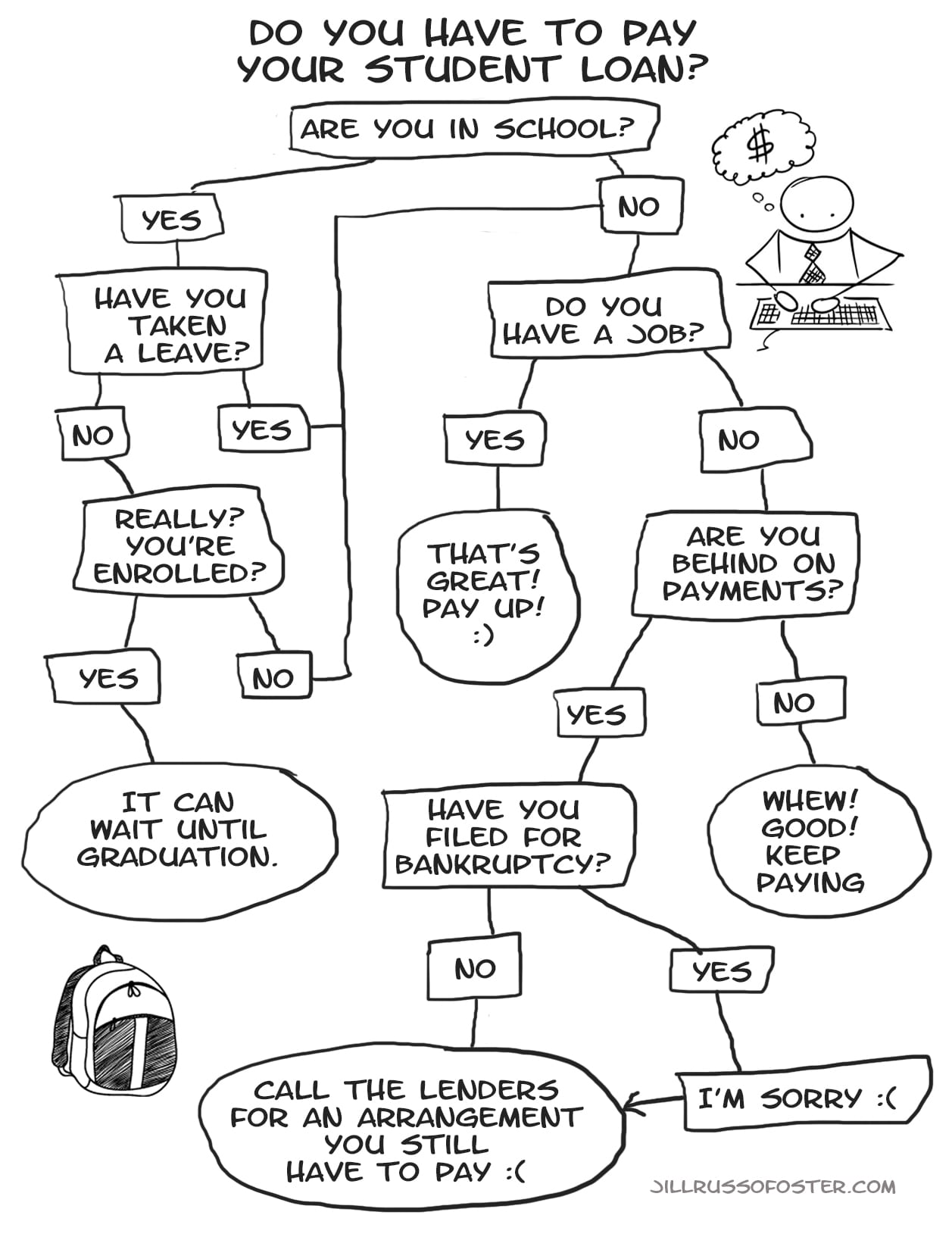
student-loan-flowchart2betterB

The last word on student loans for this series is about repayment.  There are lots of things you need to be aware of.  I am speaking about government loans.  It may be the same for private loans, but not necessarily.  You will need to check with your lender.

Never ignore any debt, especially student loans.  Student loans are not included in bankruptcy. They have to be repaid. Interest charges add up, so sooner is better than later.

Student loans are deferred while you are in school.  If you plan on taking a year or a semester off,  you will have to start making payments. Will the loan go into deferment again when you return? Contact the lender to find out.

If you are having trouble repaying your student loans contact your loan servicer.  Yes, this can be a scary call.  Trust me, lenders want their money and most of the time they are willing to work with you to find a solution that works for you and them.  Never promise to pay more than you can afford.

Some students have no idea what they owe or how many loans they have.  This is not uncommon. As students scramble to make tuition, they may take out loans with several lenders over the years. They may also consolidate some loans while leaving others intact. If you feel like you’re missing the full picture, check your credit report at AnnualCreditReport.com to see a complete list of all outstanding debts.  If you only want to see your government loans, you can go to the National Student Loan Data System (NSLDS).

Stay on top of all your debt to keep your finances in control.

What You Should Do Before Taking Out A School Loan

Let’s talk about paying for tuition. Last issue we discussed financial aid – specifically, the importance of submitting your FAFSA application as soon as possible.  While it’s nice to get financial aid, many students don’t qualify.  I am one of them. So what can you do?

Apply for a Scholarhip

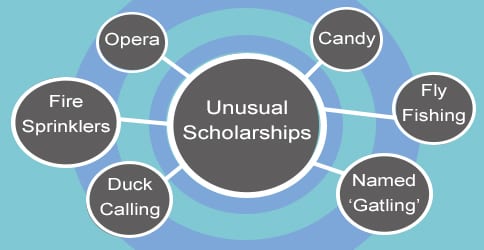
scholarships-unusual-2

Many scholarships require a FAFSA application, so get moving on it.

What scholarships should you apply for? Look for ones that meet your skills, interests or living status. For example:

  • Extra-curricular achievements like sports, music, theater, or technical competitions. If you have a talent, there may be a scholarship for you. Schools stay competitive partly through their extra-curricular programs, so they’re willing to pay. Look beyond the school as well, because there may be an outside group interested in advancing your particular skill set.
  • Potential major or field of study. These scholarships are created to draw interest or excellence to a particular field. It may be initiated by the school, a group of professionals, or a single wealthy donor. If you know what you want to study, look for a matching scholarship.
  • Your living status. Often initiated by a person or a group who has “been there,” knows that’s where you are, and wants you to succeed regardless. It could be for students who come from a particular town, a particular ancestry or ethnic group, whose parents are veterans of foreign wars, who have a particular medical condition, or who are single parents. It could be anything, really. Who knows how many scholarships like this are out there?

Read over the requirements carefully to make sure you meet them.  Don’t waste your time, or theirs, by applying for a scholarship you won’t get because you aren’t Polish American or haven’t studied dance.

Be prepared to write essays, get references and provide any proofs required.  This will take time and effort, but if you receive a scholarship – Yay! You got free money!

Student Loans – The Last Resort

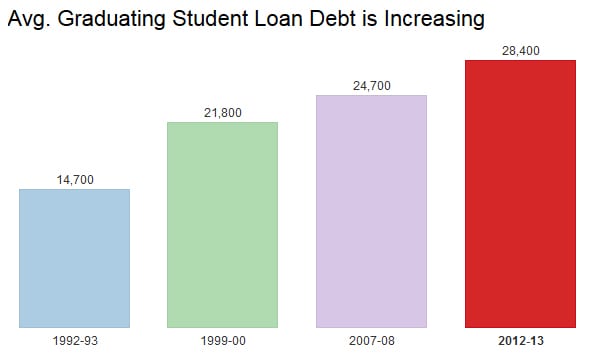
2013-student-loan-debt

According to US News and World Report,  69% of graduating students in 2013 had an average of $28,400 in student loan debt. Depending on the college (state or private), the actual range was between $2,500 and $71,000.  This is a huge amount of debt to start your career with.

How to choose a loan:

  • Always start with subsidized loans versus unsubsidized student loans, and take government loans before private. Student loans are always changing, so do your research for the most up-to-date rates and conditions.
  • Use a student loan calculator to determine your future payments (US Department of Education Online Repayment Estimator).

Understand your student loans before you sign to protect your future financial well-being.

Move Faster on Your FAFSA

It’s that time of year again!  I’m not talking about taxes.

You DO need your tax return, but that is only part of it.  Any guesses?FAFSA-Aide

It’s FAFSA – Free Application for Federal Student Aid.  I personally applied last year at this time and here are some of the things I learned. If you are returning to school or have a child in going or in college, you need to read this.

Deadlines: There are several deadlines that you need to take into consideration – federal, state and the college you will be attending.  The federal deadline is June 30. The Connecticut deadline is February 15.  Deadlines for your state can be found at fafsa.ed.gov.

How to Apply: First, you need to go to the FAFSA.gov and start your application.  Online application are easy, but as with anything, take your time and enter your information correctly.  Don’t hit enter yet.

Double Check Before Submitting! If you didn’t qualify, it could be because of wrong or inaccurate information. Did you know that incorrectly filled out applications is the reason why most government grants are denied?

Do Your Income Taxes Right Now:  You will have to link your tax return to the application.

“Sign” Your Application: How can you provide your signature on an internet document. You will use a PIN that is provided for you when you start the application process.

Need Help? Either contact the college or university financial aid office,  read the instructions directly on the FAFSA’s website or call the number listed there.

First Come, First Served: Remember,  that sometimes award monies are based on first application in – first application out. The  earlier you submit your application the better, as the money goes fast.

Where will you go this year? Free Travel Class in February

Learn how to travel for Nearly Free!

-> Sign up here for the full free package including handouts

-> Sign up here if you want to go directly to the Facebook group.

Learn more at jillrussofoster.com/nearlyfreetravel

  • « Previous Page
  • 1
  • …
  • 49
  • 50
  • 51
  • 52
  • 53
  • …
  • 83
  • Next Page »
  • Facebook
  • LinkedIn
  • Pinterest
  • Twitter
  • YouTube

Contact Jill:

Email: jrussofoster@gmail.com or use this form.

Looking for something?

Follow Jill Russo Foster’s board Money on Pinterest.

Copyright © 2026 Jill Russo Foster